Week One
The FAMSI foundation ceased functioning some years ago, but its old website is still a great resource. I especially recommend John Pohl's brief summary of Mesoamerican history.
One of the very few timelines that includes the ancient Americas comes from the Metropolitan Museum of Art. (Note/¡ojo! that Mexico is listed as "Central," not "North," America).
Janine Gasco is an ethnohistorian working on the southern Pacific Coast, where much of ancient Mesoamerica's cacao came from. Ethnohistory combines archaeology, linguistics, anthropology, and history to explore the Native American past.
Some recent research on earliest origins of indigenous Americans:
The Beringian crossing via linguistics, genetics, and also a great 20-minute lecture, here)
The oldest evidence so far of human dispersal from Beringia is from Zacatecas, Mexico.
One of the oldest skeletons (12-13,000 yrs old) is from the Yucatan.
The oldest settlement is Monte Verde, way down in Chile.
Week Two
Blessing of the siembra in Tlachichilco (Verzcruz), and the Fiesta de Elote in Chalingo (Hidalgo), 2014.
Mark van Stone on Maya and other Mesoamerican sacrifice and the Mesoamerican ball game.
The latest news from Teotihuacan : liquid mercury pools, tunnels, and royal tombs
in the pyramids of the Sun and the Moon.
A spectacular find: a "lost" Postclassic city in Honduras, or perhaps it's not that city and it wasn't lost.
Does it matter that Mel Gibson's Apocalypto conflated the Classic Maya with the Postclassic Aztecs?
The Templo Mayor Museum is run by Mexico's renowned National Institute for Anthropology and History.
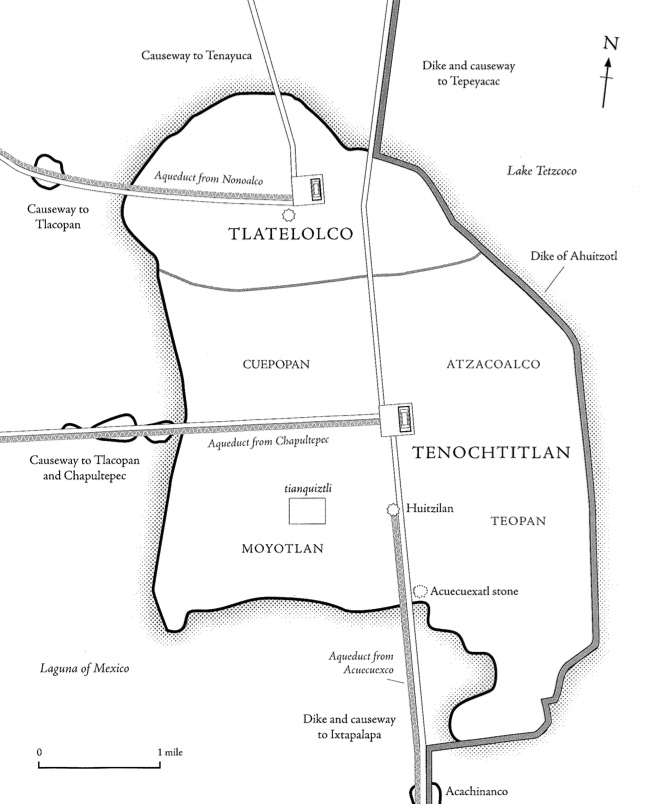
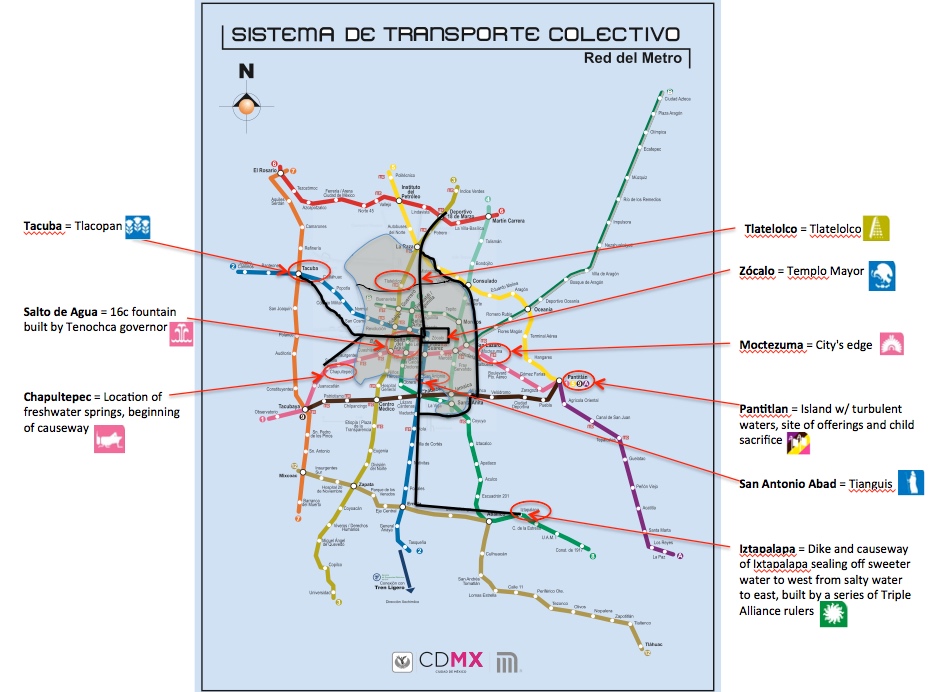
The watery city superimposed on a Mexico City metro map
Why was it believed that the Aztecs greeted Cortés as a deity?
Be getting ready to volunteer for a part in our production of the Coloquio on the Virgen of Guadalupe!
Come to class Thursday with several options, in case you don't get your first choice.
Mexico's early colonial churches
Controversy over the canonization of Franciscan evangelist of California,
Junipero Serra
Filipinos are a part of Mexican history!!
From the Spanish invasion of the islands in 1571 to the farmworker strikes of Filipino and Mexican immigrants in Southern California in the 1960s-80s.
The casta paintings of 18c Mexico
Afromexicanos were recognized on the Mexican census in 2015
We meet all this week in Straz Tower 295
Come early if possible!
The Basilica of St. Mary of Guadalupe in Mexico City
Wishing her a happy birthday
A mural/fountain for the Virgen in San Antonio, TX
It is really hard to find the entire Virgen de Guadalupe series by Chicana artist Yolanda López on the internet!
We meet Tuesday in Straz Tower 295. On Thursday, we're back in the regular classroom.
On Tuesday, we will start immediately with Act I so come to class as early as you can to help set up and be ready. I will be there twenty minutes prior. Those who are able should plan to help clean up afterwards, and thank you.
On Thursday, we'll discuss the play and Taylor article and prepare for Quiz #2.
Be thinking about the most important things the Coloquio reveals about colonial society.
At the unlikely risk of devolving into nostalgia for my 7th-grade Texas History class ... YouTube offerings on the War of Texas Independence (okay, I can't completely shake it) and La invasión norteamericana.
Johnny Cash sings "Remember The Alamo"
John Wayne talks about The Alamo
The official annual commemoration of the Battle of Chapultepec
Gustavo Arellano on the "reconquista"
of the American Southwest
All you ever wanted to know about Santa Anna's peg leg ... which some university students from Texas tried to get repatriated to Mexico ... and Cerro Gordo, IL
La cocinera poblana -- look for other historic cookbooks on Hathitrust.org
Postcards with images of the Mexican Revolution were common, especially along the Mexico-U.S. border.
The Olvera St. mural of David Siqueiros, called "América Tropical," was whitewashed over in 1932 by its patron soon after its completion, for its theme of U.S. imperialism. Siqueiros's first outdoor mural, it was restored at its original site in Los Angeles in the late 1960s and again in the 2010s.
José Clemente Orozco painted at Dartmouth College
All the El Santo movies and Mexican horror films
(Capitalizing on El Santo's fame, a university student in 2005 made this short piece "El Santo y los burócratas" starringthe equally famous son of El Santo fighting against Mexican bureaucracy. In 2006, the federal government's non-partisan elections oversight board made a short film promoting voter registration that was so similar, the student accused it of plagiarism!)
National Security archive, UNAM's chronology, and Radio Diaries
on the Tlatelolco massacre
The music festival Avándaro in 1971 was Mexico's Woodstock.
In 2006, Mexico quietly released the long-promised report on its own "Dirty War" against student and others anti-government activists from the late '60s through the '80s.
How the wealthy avoid the metro: aerial photos of Mexico City
Documents by and about the Zapatistas, and an interview with Subcomandante Marcos (you can link to parts 1 and 3 from here, too).
An interview with Carlos Salinas de Gortari in Spanish with Jorge Ramos of Univisión, and a longer one (also in Spanish) from the Grupo Reforma (parent company of the Mexico City daily Reforma). Carlos's brother Raúl was acquited on appeal of the murder of his brother-in-law in 2005.
Changes to Mexican (and Central American) migration to the U.S., circa 2000:
rural areas, meatpacking, and dairy, from the Migration Policy Institute
John Bowe on Mexican and Guatemalan workers in Florida
and the Coalition of Immokalee Workers home page
One of my favorite Selena videos and the very best podcast about her legacy.
Marine private Guy Gabaldon, the "pied piper of Saipan," a Mexican-American whose WWII story was told (without reference to his ethnicity) in the movie Hell to Eternity.
Marine lance corporal José Gutierrez, a Guatemalan immigrant and one of the first soldiers to die in Iraq.
The Kerry Commission report headed in 1988 by senators John Kerry and Mitch McConnell,
on feuding factions within the U.S. government's war on drugs.
The PBS news program Frontline summarized the situation from a U.S. point of view at the time.
Brown University students created a page on the Iran-Contra affair
The National Security Archive on the Ayotzinapa case of 43 students disappeared in 2014. Over 100,000 Mexicans are officially registered as "disappeared" since 1964.
Paul Gootenburg on the historical development of cocaine
Vanda Felbab-Brown of the Brookings Institute is amazing;
this report on the narcotics trade and worldwide counternarcotics initiatives is still relevant.